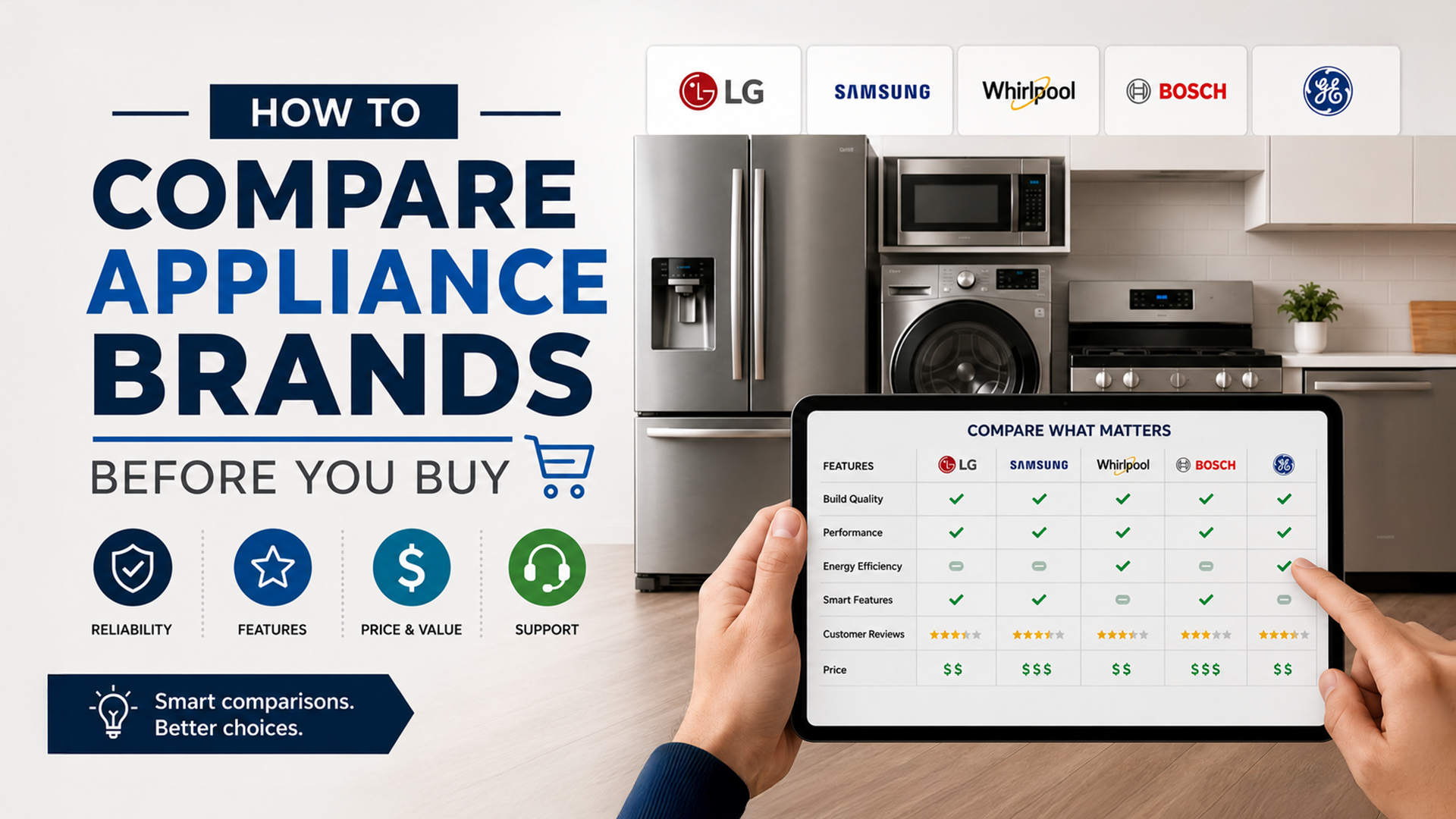
How to Compare Appliance Brands Before You Buy
This article was generated using AI and reviewed by a human editor for quality and accuracy.
A refrigerator that fits your opening but cannot fully open beside an island is not a good value. Neither is a laundry pair with impressive features that requires electrical or venting changes your home does not support. Knowing how to compare appliance brands starts with your room, your daily routine, and the service you expect after delivery - not a logo, a sale price, or a single online review.
Major appliances are long-term purchases. A brand may be an excellent choice for a quiet dishwasher, for example, while another may offer a better cooking lineup or more flexible refrigeration options. The right comparison looks at the products you are actually considering and the practical details that affect ownership.
Start With Your Needs, Not Brand Reputation
Before comparing brands, define the job the appliance must do. For a replacement purchase, that may mean matching an existing cutout, fuel type, and capacity. For a kitchen renovation or new build, you have more freedom, but also more decisions about layout, ventilation, panel readiness, and appliance coordination.
Write down the non-negotiables first: available width, height, and depth; utility requirements; household size; and target budget. Then separate features into two groups: those you will use every week and those that are simply nice to have. A family that runs the dishwasher nightly may prioritize rack flexibility, cycle performance, and low noise. A frequent entertainer may place more value on a larger refrigerator, a second oven, or an ice maker with higher production.
Brand comparisons become more useful once you are comparing like for like. A 24-inch built-in dishwasher should be evaluated against similar 24-inch built-in models, not against a lower-priced portable unit with a different purpose. The same applies to freestanding versus built-in refrigeration, gas versus induction ranges, and top-load versus front-load washers.
How to Compare Appliance Brands by Category
No appliance brand is automatically the best choice in every category. Many manufacturers have clear strengths based on engineering priorities, price position, style, and product depth. Compare the specific category first, then consider whether a single-brand package makes sense for your project.
Refrigeration: Capacity, Preservation, and Installation
For refrigerators, begin with configuration: French door, side-by-side, bottom freezer, top freezer, column, or built-in. Measure more than the cabinet opening. Account for door swing, handles, ventilation clearance, delivery paths, and the depth of surrounding counters.
Then compare usable interior space rather than relying only on total cubic feet. Adjustable shelves, gallon-door storage, drawer layout, and freezer organization can make one model easier to live with than another of similar size. If food preservation is a priority, look closely at temperature management, humidity-controlled drawers, air filtration, and dual-evaporator systems.
Luxury and built-in brands may offer a more integrated appearance, panel-ready options, and specialized preservation features. Those advantages can justify the investment in a design-focused kitchen, but installation requirements and service access should be confirmed early.
Cooking: Match the Fuel, Format, and Cooking Style
Cooking appliances require a practical comparison of fuel type and cooking habits. Gas cooking offers visible flame control and remains a familiar choice for many home chefs. Induction provides fast response, efficient heating, and a cooler cooktop surface, but it requires compatible cookware and appropriate electrical capacity. Electric radiant cooking may be the most straightforward replacement option in some homes.
For ranges, compare oven capacity, burner or element layout, convection systems, air-fry modes, cleaning cycles, and control design. A professional-style range may offer higher output and visual impact, but it can also require a properly sized ventilation system and more careful planning. Wall ovens provide flexible placement and can be ideal for accessible kitchen layouts, while ranges often deliver more cooking capacity per dollar.
Do not assume more features mean better results. If you mostly bake, dependable temperature performance and rack placement may matter more than a long menu of preset modes. If you cook large meals, burner spacing and the ability to handle multiple pans at once may be the deciding factors.
Dishwashers and Laundry: Focus on Daily Friction
With dishwashers, compare sound ratings, rack configuration, drying performance, cycle times, and leak protection. A quiet model is particularly valuable in an open kitchen or when the dishwasher runs after bedtime. Third racks and adjustable middle racks can be genuinely useful, but only if they accommodate the dishes, glassware, and cookware your household uses.
For laundry, capacity is only one part of the decision. Front-load washers can offer efficient water use and strong cleaning performance, while top-load models may appeal to shoppers who prefer simpler loading and shorter familiar cycles. Compare matching dryer options, venting requirements, stacking compatibility, pedestal availability, and cycle settings for bulky bedding, activewear, or delicate fabrics.
A ventless heat-pump dryer can be a practical solution where exterior venting is difficult, though drying times and installation planning differ from conventional vented dryers. This is a good example of why a brand should be judged on fit for the home, not just feature count.
Look Beyond the Purchase Price
The lowest advertised price does not always represent the lowest cost of ownership. When you compare appliance brands, include the items that make the appliance usable in your home: delivery, installation, haul-away, required cords or hoses, trim kits, water lines, conversion kits, ventilation components, and any necessary utility work.
Energy and water use also deserve attention, especially for refrigerators, dishwashers, and laundry appliances that operate frequently. An efficient model may cost more at purchase but reduce ongoing operating expenses. The trade-off depends on how long you expect to own it and how heavily your household uses it.
Rebates, package promotions, and financing can change the value equation, particularly when purchasing several appliances for a kitchen project. Compare the final delivered and installed price of each option, rather than making a decision from a percentage-off offer alone.
Evaluate Reliability With Context
Reliability matters, but broad statements such as “this brand never needs service” are rarely useful. Every manufacturer has product lines, model generations, and individual units that perform differently. Read current product information and customer feedback for patterns, not isolated stories.
Pay attention to recurring comments about issues that would affect your household, such as ice maker performance, dishwasher drying, control responsiveness, washer vibration, or difficult-to-clean surfaces. At the same time, weigh reviews against the number of units sold and the complexity of the product. A feature-rich smart refrigerator has more components than a basic top-freezer model, so their ownership experience should not be judged by the same standard.
Warranty coverage is part of this evaluation. Compare the standard warranty term, what it covers, and whether extended protection is available for the product type. Ask how warranty service is coordinated in your area and whether authorized technicians are available for the brand you choose. For premium or built-in appliances, local service support can be as important as the appliance specification itself.
Compare Design, Controls, and Package Compatibility
Appliances should work together visually and functionally, but matching badges are not always required. A single-brand package can create a coordinated finish, handle style, and control aesthetic. It may also simplify package pricing and give you access to a broader suite of compatible products.
Mixing brands can be the better choice when one manufacturer offers the refrigerator configuration you need and another provides the cooking performance or laundry format you prefer. Keep the visible details consistent where possible: finish tone, handle style, appliance scale, and installation height. Stainless steel is not always identical from one brand to another, and black stainless finishes can vary even more noticeably.
Try the controls when possible. Open the refrigerator doors, adjust dishwasher racks, turn range knobs, and examine the washer dispenser. A clean-looking touch panel may suit one household, while another will prefer tactile knobs and straightforward controls. These small interactions add up over years of use.
Use Expert Guidance Before You Commit
Specifications can answer many questions, but they cannot see the corner that complicates a delivery or identify a ventilation conflict from a product page. Bring room dimensions, photos, and a list of priorities to an appliance specialist before placing a large order. For renovation projects, involve your designer, contractor, or cabinet professional early enough to coordinate cutouts, electrical, plumbing, and ventilation.
At Plesser's Appliances, shoppers can compare a broad range of mainstream and luxury brands while getting practical guidance on product fit, delivery, installation, package opportunities, and available support. That combination is particularly useful when a project includes more than one appliance category.
The best brand choice is the one that fits your space, supports the way your household lives, and can be delivered and serviced with confidence. Bring your measurements and priorities to the decision, and let the details - not the nameplate alone - guide your purchase.
Take Your Appliance
Knowledge from Good to Great
Just Ask Al is your go-to expert platform to connect, share, and learn — together. Join the Community on Facebook to get expert insights, tips, and more.
Collaborate with fellow appliance enthusiasts today!
38,000+ members and growing
Join the community today—everyone is welcome!


Take Your Appliance Knowledge With You On The Go!
Just Ask Al is your go-to expert platform to connect, share, and learn — together. Join the Community on Facebook to get expert insights, tips, and more.
Collaborate with fellow appliance enthusiasts today!