Slide In Range vs Freestanding Compared
This article was generated using AI and reviewed by a human editor for quality and accuracy.
A range replacement can look straightforward until you measure the opening and notice the details around it. In the slide in range vs freestanding decision, the right choice affects more than appearance. It can determine whether your new appliance fits your existing space, how clean the finished installation looks, and how much you spend on the purchase and any kitchen updates.
Both styles combine an oven and cooktop in one appliance, and both are available with gas, electric, dual-fuel, induction, convection, air fry, smart controls, and other popular features. The difference is primarily in how the range is designed to sit between your cabinets and where its controls are located. Knowing what that means in a real kitchen will help you shop with confidence.
Slide In Range vs Freestanding: The Main Difference
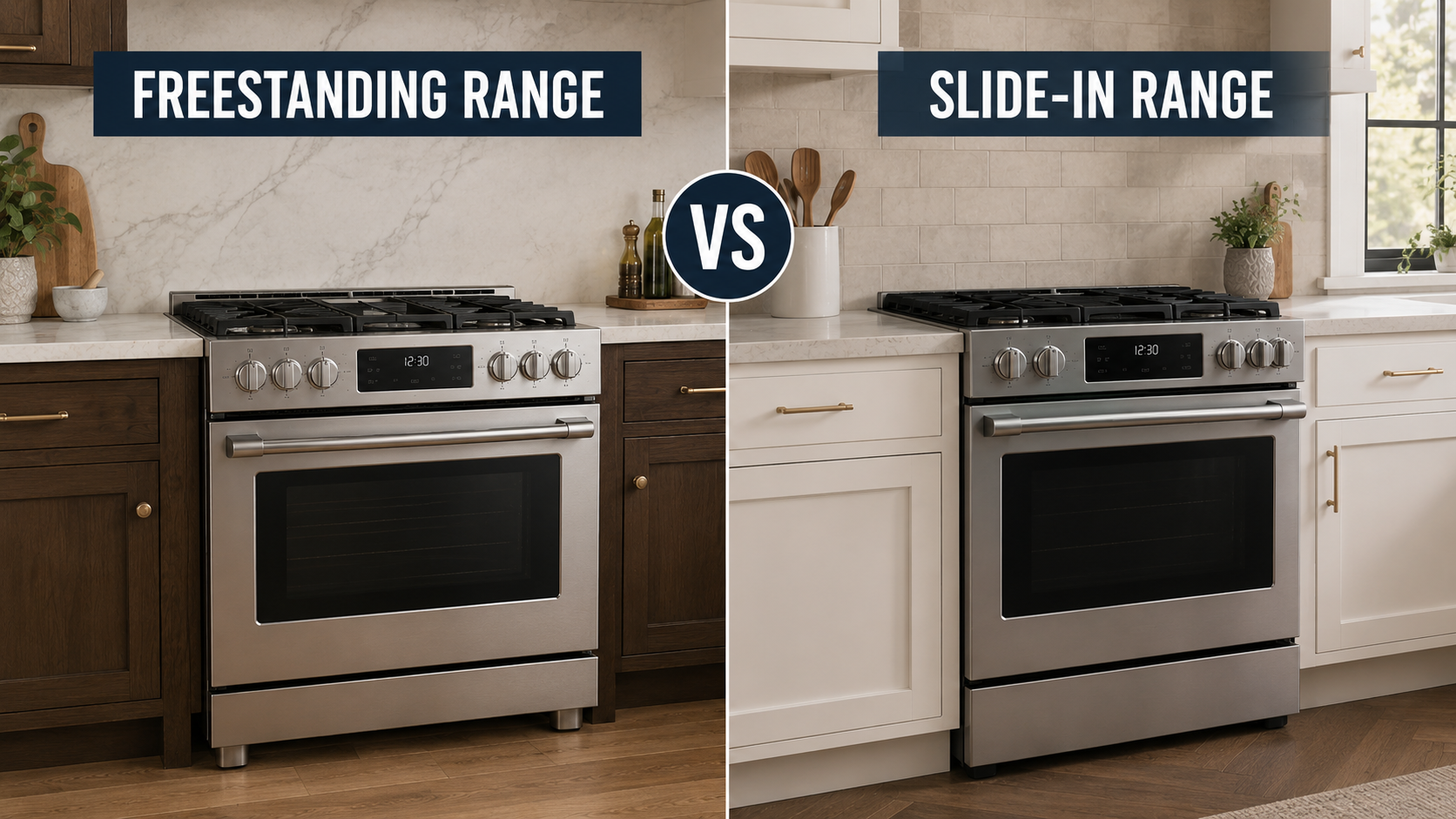
A freestanding range has finished sides and is built to stand on its own or fit between cabinets. Most traditional freestanding models have a backguard - the raised panel behind the cooktop that commonly holds the controls. This design is familiar, flexible, and well suited to replacement projects where the range may sit at the end of a cabinet run.
A slide-in range is intended to slide into a prepared opening between base cabinets. It typically has front-mounted controls and no tall rear control panel. Many models include an overlapping cooktop lip that rests slightly on the countertop edges, creating a more built-in appearance and helping reduce crumbs and spills in the gaps beside the appliance.
The visual distinction is clear from across the room. A slide-in range lets the backsplash remain visible behind the cooktop, while a freestanding model usually creates a taller visual break at the back of the range. Neither is automatically better. The best option depends on your cabinet layout, remodeling plans, cooking habits, and budget.
Why a Freestanding Range Works for Many Homes
Freestanding ranges remain a practical choice for many households because they are versatile and often offer strong value. Their finished sides allow installation where one or both sides are exposed, such as at the end of an island, along a short wall, or in a compact kitchen without a fully enclosed range opening.
For a like-for-like replacement, a freestanding range can also simplify the process. If your existing appliance has a rear control panel and the surrounding countertops were cut around that design, a new freestanding model may fit with fewer changes. There is no need to assume that every 30-inch range has identical clearance requirements, however. The width may be standard, but depth, handle projection, electrical connections, gas connections, and manufacturer-specified side clearances vary.
The rear control panel can be an advantage for families who prefer knobs and buttons positioned farther from the front edge of the cooktop. It also keeps controls away from hot pans at the front of the range. On the other hand, the panel partially covers the backsplash and can make it less convenient to reach across steaming cookware to adjust oven settings.
Freestanding does not mean basic. Many current models provide high-output gas burners, flexible electric elements, induction cooking, true convection, built-in air fry modes, temperature probes, and Wi-Fi-enabled features. A freestanding range can deliver high-level cooking performance without requiring a more integrated kitchen design.
When freestanding is the better fit
Choose a freestanding range when you need finished side panels, want the broadest selection at a range of price points, or are replacing a similar model without changing cabinetry. It is also a sensible option for rental properties, budget-conscious updates, and kitchens where the range location may change in a future renovation.
What a Slide-In Range Brings to the Kitchen
A slide-in range is often selected for its cleaner, more custom appearance. With controls on the front, the appliance sits lower visually and allows tile, stone, or a decorative backsplash to remain the focal point behind the cooking surface. For renovated kitchens, that detail can make a meaningful difference.
Front controls also make it easier to adjust a burner or oven setting without reaching over the cooktop. This is especially useful when large stockpots, griddles, or roasting pans are in use. For households with young children, front controls should be considered carefully. Look for control lock functions and review how easily knobs can be turned, rather than choosing solely based on control location.
The countertop overlap found on many slide-in ranges gives the installation a more finished edge. It can help limit food debris falling into the narrow seams between the appliance and counter. Still, it is not a substitute for correct installation. The opening must be measured precisely, and the countertop edge must be level and properly supported.
Slide-in models are particularly appealing for homeowners who are updating cabinetry, counters, and backsplash at the same time. They are also popular in kitchen designs where the range is positioned as a central feature, including spaces with a statement hood or a full-height stone backsplash.
Slide-in installation details to verify
Before ordering a slide-in range, measure the cabinet opening at the front and rear, not just in the middle. Check the countertop depth, finished floor height, nearby drawers, and the clearance to the wall behind the appliance. Some slide-in models are designed with a rear filler strip or other installation accessory to address a gap at the back, but requirements differ by model.
You should also confirm the fuel and power requirements. Gas ranges require a properly located gas supply and typically a grounded electrical outlet for ignition and electronic features. Electric and induction ranges generally require a dedicated 240-volt circuit. A range cord is not always included, so review the product specifications and installation requirements before delivery day.
Professional delivery and installation can be especially valuable when replacing an appliance in a tight opening. The goal is not simply to get the range into the kitchen. It is to level it, connect it correctly, secure the anti-tip bracket, and make sure doors, drawers, and cabinet hardware can operate as intended.
Price, Features, and Long-Term Value
At comparable feature levels, slide-in ranges often cost more than freestanding models. The price difference reflects their design, front-control configuration, and the demand for a built-in look. However, the gap is not universal. A feature-rich freestanding induction range may cost more than an entry-level slide-in electric range.
Focus on the features your household will actually use. Frequent bakers may value convection performance, multiple oven racks, and precise temperature control. Busy families may prioritize easy-clean cooktop surfaces, a quick preheat function, and larger oven capacity. For serious home cooks, burner output, low-simmer capability, induction responsiveness, and oven consistency may matter more than the style of the control panel.
Consider the cost of the complete project as well. A lower-priced range is not necessarily the lower-cost option if it requires countertop modifications, electrical upgrades, gas-line work, or cabinet repairs. Conversely, a slide-in range can be a worthwhile investment when it completes a larger kitchen renovation and supports the look you want for years to come.
Measure First, Then Compare Models
Start with the manufacturer dimensions for the exact range you are considering, not a general category measurement. Record the opening width, depth from the wall to the front of the countertop, counter height, and the space above and beside the range. Also note whether the appliance will have exposed sides and whether its door will clear an island or opposite cabinet run when fully open.
For most homeowners, the decision becomes simple once the kitchen is evaluated honestly. A freestanding range offers flexibility, broad selection, and an easy path for many replacements. A slide-in range offers a polished, cabinetry-integrated appearance and convenient front controls, but demands closer attention to the opening and installation details.
If you are choosing between two models, bring your measurements, fuel type, and a photo of the range area to an appliance specialist. A few minutes spent matching the range to the space can prevent an expensive delivery-day surprise and help ensure your new kitchen appliance looks as good as it cooks.
Take Your Appliance
Knowledge from Good to Great
Just Ask Al is your go-to expert platform to connect, share, and learn — together. Join the Community on Facebook to get expert insights, tips, and more.
Collaborate with fellow appliance enthusiasts today!
38,000+ members and growing
Join the community today—everyone is welcome!


Take Your Appliance Knowledge With You On The Go!
Just Ask Al is your go-to expert platform to connect, share, and learn — together. Join the Community on Facebook to get expert insights, tips, and more.
Collaborate with fellow appliance enthusiasts today!