Panel Ready Appliances Guide for Kitchen Planning
This article was written by Logan H. and reviewed with assistance from AI tools for clarity and accuracy.
A refrigerator that disappears into the surrounding cabinetry can make a kitchen feel considered rather than crowded. That is the appeal of integrated design, but a successful result depends on more than choosing an appliance with a matching door panel. This panel ready appliances guide covers the planning decisions that protect your budget, your cabinetry, and the finished look of the room.
Panel-ready appliances are especially popular in renovated kitchens, custom homes, and spaces where homeowners want the cabinetry to remain the visual focus. They can also be a practical choice in compact kitchens, where reducing the number of visible finishes helps the room feel less busy. The trade-off is that panel-ready appliances require earlier coordination than standard freestanding models.
What Does Panel Ready Mean?
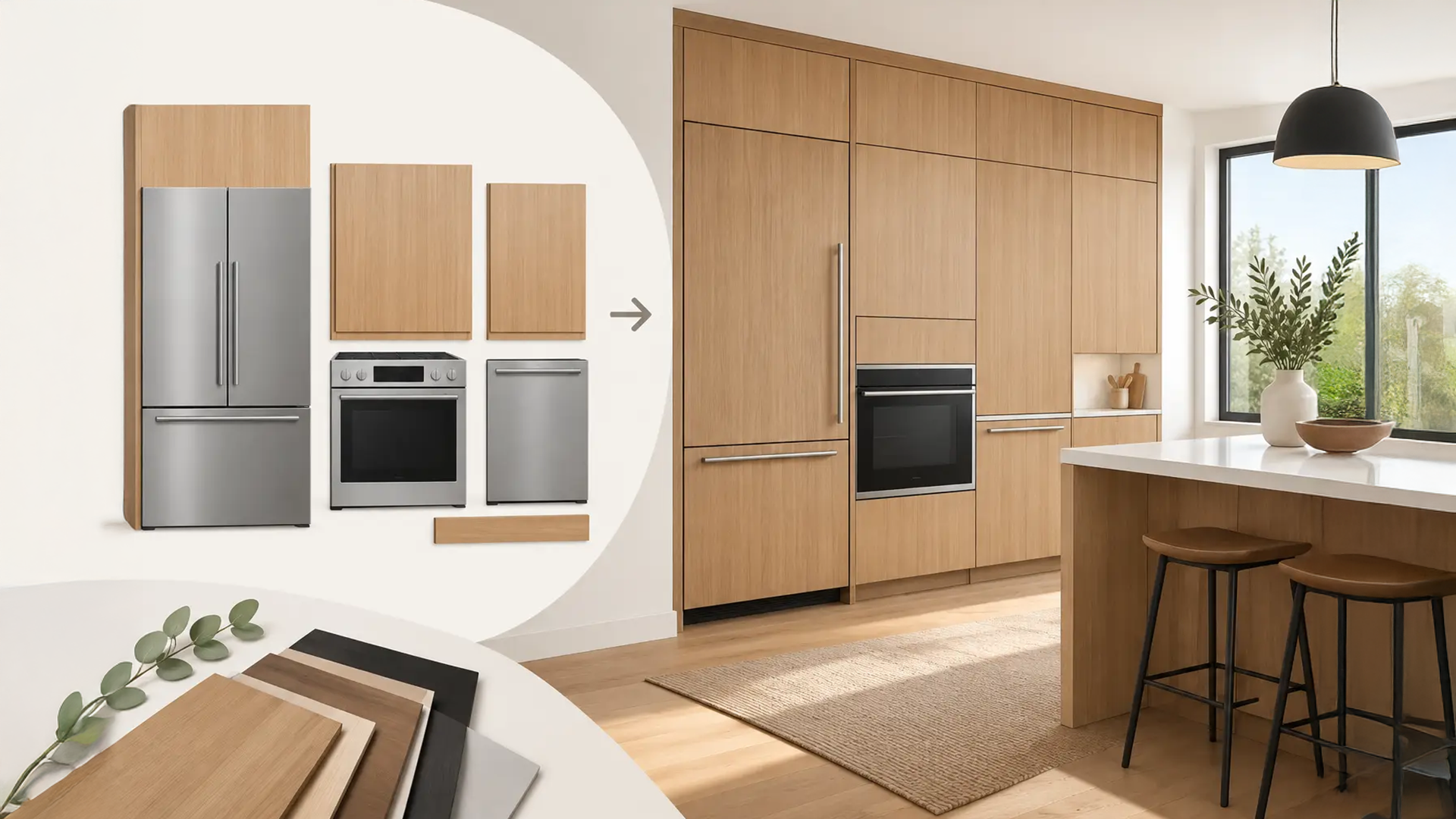
A panel-ready appliance is designed to accept a custom cabinet panel on its front. Once installed, the appliance can blend with adjacent cabinetry rather than displaying a stainless steel, black, or white factory finish. Refrigerators, dishwashers, undercounter beverage centers, ice makers, wine coolers, and some laundry appliances are available in panel-ready configurations.
Panel-ready does not always mean fully hidden. Some models have visible handles, control panels, ventilation grilles, or trim. Others are fully integrated and sit nearly flush with surrounding cabinets, often using a concealed control panel and a toe-kick that continues the cabinet line. The product specifications will identify the intended installation style.
This distinction matters because the word "integrated" is sometimes used broadly. A panel-ready dishwasher may accept a cabinet front while still projecting slightly beyond the cabinetry. A fully integrated refrigerator may require custom panels, specialized hinges, and precise clearances to achieve a built-in appearance.
Panel Ready Appliances Guide: Where Planning Starts
The appliance selection should happen before cabinet orders are finalized. Cabinetmakers, designers, contractors, and homeowners need the exact appliance model number to confirm cutout dimensions, panel dimensions, required clearances, electrical needs, plumbing locations, and ventilation space.
A standard-width appliance is not automatically a standard installation. A 36-inch panel-ready refrigerator, for example, may require a specific cabinet opening, side gaps for door swing, and a designated air path above or below the unit. A dishwasher needs room for water and drain connections, plus enough clearance for the door to open without hitting a nearby island or drawer pull.
Share the appliance installation guide with everyone involved in the project. The cabinet panel itself is often supplied by the cabinetmaker, not the appliance manufacturer, and it must meet the manufacturer’s requirements for thickness, weight, height, and mounting-hole placement. Ordering a panel before confirming those details can lead to expensive revisions.
Measure the Entire Installation, Not Just the Opening
The width and height of a niche are only part of the equation. Confirm the depth from the finished wall to the front of the cabinets, including baseboards, outlet boxes, water lines, and flooring transitions. Check whether refrigerator doors can open fully near a wall and whether the appliance can be brought through doorways, halls, and staircases during delivery.
For built-in refrigeration, the finished cabinet depth and door style are particularly important. A thick shaker-style panel can affect how far the refrigerator doors open and how the panels align with neighboring doors. The goal is a clean reveal around the appliance without limiting access to drawers, crisper bins, or interior shelves.
Which Appliances Work Best With Custom Panels?
Refrigeration delivers the most dramatic visual change. A panel-ready column refrigerator and freezer can create a furniture-like wall of cabinetry, while a panel-ready French door or bottom-freezer refrigerator offers a similar concept in a more familiar format. Columns provide flexibility in size and placement, but they usually require a larger investment and more detailed cabinet planning.
Dishwashers are often the easiest starting point. A panel-ready dishwasher can disappear beneath the countertop and maintain a continuous run of base cabinets. Many homeowners choose this option when a large stainless appliance would interrupt a painted, stained, or natural wood kitchen design.
Undercounter refrigeration is another strong fit. Panel-ready beverage centers, wine storage, and ice makers can keep a bar, pantry, or entertainment area visually quiet. Be sure to select a model rated for the intended location. An indoor unit is not necessarily approved for an outdoor kitchen or garage.
Panel-ready laundry appliances are less common, but they can be useful in mudrooms or laundry rooms that share space with storage cabinetry. These installations require special attention to ventilation, access for service, and the clearance needed for doors to open.
Cost Considerations Beyond the Appliance Price
Panel-ready appliances generally cost more than comparable freestanding models, particularly in refrigeration. The appliance price is only one part of the budget. Custom door panels, handles, cabinet modifications, delivery logistics, installation, and possible trim kits should all be included in the project estimate.
A dishwasher panel may be relatively straightforward, while a pair of refrigeration columns can involve multiple panels, matching toe-kicks, fillers, and precise finishing work. If the cabinetry is being painted, ask whether the appliance panels will be finished at the same time as the cabinet doors. Matching a color later can be difficult, especially with hand-applied stains or custom paint formulas.
There is also a long-term consideration. If an appliance needs replacement years later, the existing panel may not fit a new model. Choosing a well-supported model and keeping the installation documents can make a future replacement easier. In some cases, a designer may plan fillers or removable trim to give the project a little more flexibility.
Ventilation and Service Access Are Not Optional
A concealed appliance still produces heat and needs access for maintenance. Refrigerators and wine storage units have exact ventilation requirements that cannot be covered by decorative panels, crown molding, or tight cabinetry. Ignoring these requirements can affect performance, increase noise, and potentially shorten the appliance’s service life.
Service access should be discussed before installation. Water shutoff valves, electrical connections, and leveling legs need to be reachable when repairs or replacement are needed. For a dishwasher, this may mean placing the water shutoff in the adjacent sink cabinet rather than directly behind the unit. For refrigeration, follow the manufacturer’s instructions for securing the appliance and accessing connection points.
A qualified installer can help identify issues before delivery day, but installers cannot correct cabinetry that was built to the wrong specifications. Confirming the details early is the easiest way to avoid delays.
Choosing the Right Look for Your Kitchen
Panel-ready is not automatically the right choice for every kitchen. Stainless steel remains durable, familiar, and easy to coordinate with many cooking appliances. It can also be more economical and simpler to replace. In a kitchen with a stainless range and wall oven, a stainless refrigerator may create a deliberate, balanced appliance suite.
Custom panels make the strongest case when cabinetry is the centerpiece of the design. They work especially well with traditional inset cabinets, modern flat-panel doors, warm wood finishes, and open-concept spaces where the kitchen is visible from living and dining areas. They can also help conceal refrigeration in a butler’s pantry or secondary kitchen.
Consider the hardware plan before committing. Some panel-ready appliances are designed for a specific handle style or proprietary handle kit, while others accept custom handles. The handle length, mounting points, and weight must meet the appliance manufacturer’s requirements. A cabinet pull that looks right on a drawer may not be suitable for a tall refrigerator door.
A Practical Buying Checklist
Before placing an order, confirm the exact model number, finished opening dimensions, panel specifications, door swing, electrical requirements, water-line location, ventilation method, and delivery path. Also verify who is supplying the panels, handles, trim, and installation labor. Those responsibilities can be split among the appliance retailer, cabinet shop, builder, and installer, so clarity prevents last-minute surprises.
For renovation projects, it is wise to order appliances early enough to provide specifications to the cabinet team, even if delivery is scheduled closer to completion. Availability can vary by brand and model, and panel-ready products are not always stocked in the same volume as standard appliances.
At Plesser’s Appliances, knowledgeable product guidance can help homeowners and trade professionals compare panel-ready options across refrigeration, dishwashing, and specialty refrigeration categories. Bring your cabinet plan, dimensions, and finish goals to the conversation so the appliance choice supports the full project.
The best panel-ready installation is one that looks effortless after careful coordination. Start with the model specifications, involve the cabinet team early, and leave room in the schedule for details that turn custom cabinetry and premium appliances into one finished kitchen.
Take Your Appliance
Knowledge from Good to Great
Just Ask Al is your go-to expert platform to connect, share, and learn — together. Join the Community on Facebook to get expert insights, tips, and more.
Collaborate with fellow appliance enthusiasts today!
38,000+ members and growing
Join the community today—everyone is welcome!


Take Your Appliance Knowledge With You On The Go!
Just Ask Al is your go-to expert platform to connect, share, and learn — together. Join the Community on Facebook to get expert insights, tips, and more.
Collaborate with fellow appliance enthusiasts today!